How Dubai Logistics Organizations Are Reducing Cloud Costs Without Slowing Innovation

Key Takeaways
Cloud cost reduction is no longer just about lowering infrastructure bills — it's about building more efficient cloud operating models.
Serverless architecture helps logistics businesses pay only for actual usage instead of idle infrastructure.
Platform engineering enables development teams to deliver software faster while maintaining governance.
Managed cloud services reduce operational overhead and help overcome cloud talent shortages.
UAE logistics companies adopting cloud-native practices gain better scalability, resilience, and operational visibility.
Dubai didn't become one of the world's busiest logistics corridors by accident. Between Jebel Ali Port, Dubai South, and a customs infrastructure built for speed, the emirate moves an outsized share of goods between Asia, Europe, and Africa. That volume now runs on cloud infrastructure — route optimization engines, warehouse management systems, customer-facing tracking portals, IoT sensors on containers, all of it sitting on AWS, Azure, or Google Cloud.
The problem is that cloud bills have grown faster than the businesses they support. Flexera's 2026 State of the Cloud Report found that wasted cloud spend rose to 29% this year — the first increase in five years — driven partly by the cost complexity that comes with new IaaS and PaaS services. Logistics companies feel this acutely — their workloads spike around peak shipping seasons, holiday demand, and port congestion events, then sit mostly idle the rest of the year. Paying for always-on infrastructure to cover a handful of peak weeks is expensive, and it's exactly the kind of waste dragging cloud budgets up across the region.
Meanwhile, IT spending across the Middle East and North Africa keeps climbing. Gartner projects MENA IT spending will reach $169 billion in 2026, up 8.9% from the prior year, with cloud and multi-cloud strategy named as one of the primary drivers. Dubai's logistics operators are investing more in technology than ever, but a growing share of that spend isn't buying them anything.
Here's the uncomfortable part: migrating to the cloud isn't what fixes this. Most logistics companies already migrated years ago. What's missing is a different operating model — one built around serverless architecture, platform engineering, and managed cloud services working together instead of as separate initiatives bolted onto legacy infrastructure.
Why Cloud Costs Are Increasing for Logistics Organizations in Dubai
If your cloud bill keeps climbing after migration, the infrastructure itself usually isn't the problem — how it's being run is.
Hidden Infrastructure Waste
Dev, staging, and test environments left running over weekends. Orphaned storage volumes attached to nothing. Load balancers pointing at services that were decommissioned months ago. None of this shows up on a dashboard unless someone goes looking for it, and in most logistics IT teams, nobody has the bandwidth to go looking.
Over-Provisioned Cloud Resources
Engineers size servers for worst-case peak demand — Black Friday shipping volumes, a major port surge — then never scale back down. A warehouse management system built to handle 10x normal traffic during two weeks in November runs at that capacity for the other fifty.
Always-On Applications
Shipment tracking APIs, notification services, and route-calculation jobs often run on virtual machines that stay powered on 24/7, even though actual usage might be a burst of requests every few minutes. You're paying for compute the application isn't using.
Fragmented DevOps Processes
When five teams each maintain their own deployment pipeline, you get five different sets of assumptions about instance sizing, security configuration, and scaling policy. Nobody owns the total cost picture, so nobody's incentivized to fix it.
Poor Cloud Governance
Without tagging standards, budget alerts, or a central view of spend by team and project, cost overruns get discovered at the end of the billing cycle instead of the moment they happen.
Traditional Cloud Model | Modern Cloud Operating Model |
Always-running servers | Event-driven workloads |
Manual provisioning | Automated provisioning |
Multiple DevOps pipelines | Internal Developer Platform |
High idle costs | Pay-per-use computing |
Limited visibility | Real-time cloud monitoring |
The shift from the left column to the right isn't a single project. It's three connected disciplines, and the first one is usually the fastest to show results.

Why Serverless Architecture Is Becoming a Strategic Advantage for Dubai Logistics Companies
Forget the technical definition for a second. What serverless actually does for a logistics business is simple: you stop paying for infrastructure sitting idle, and you start paying only when code actually runs.
That distinction matters more in logistics than almost any other industry, because logistics workloads are inherently spiky.
Peak seasonal demand — Ramadan shipping surges, year-end retail volume, port congestion events that trigger sudden spikes in tracking requests.
Shipment tracking — thousands of small, independent events (a container clears customs, a truck departs, a package is scanned) that map naturally to individual function executions.
Route optimization — computation-heavy jobs that run on demand rather than continuously.
API workloads — partner integrations and customer-facing endpoints with unpredictable traffic patterns.
Warehouse automation — sensor triggers and inventory updates that fire irregularly throughout the day.
IoT integrations — container and fleet telemetry streaming in from thousands of devices at once, then going quiet.
AI event processing — anomaly detection on shipment data, fraud checks, predictive ETAs — all short-lived compute tasks.
The business outcomes follow directly from that shift: lower infrastructure costs because you're not paying for idle servers, faster deployments because there's no server fleet to provision and patch, better scalability because the platform absorbs demand spikes automatically, and less operational overhead because there's no OS or capacity planning to manage.
Case in point: take shipment notification systems, one of the most common workloads in the logistics stack. Run on a traditional VM deployment, a notification service needs to stay online around the clock even though it might process a handful of events per minute outside of peak hours — you're paying for 24 hours of uptime to handle maybe 90 minutes of actual work. Rebuilt on AWS Lambda, Azure Functions, or Google Cloud Run, that same service only consumes compute when a shipment event actually fires. Companies working with aws lambda development services in dubai to rebuild these event-driven flows typically see monthly infrastructure costs drop sharply, simply because idle time stops being billed.
Serverless isn't free of trade-offs — cold starts and vendor lock-in are real considerations for latency-sensitive workloads — but for the bursty, event-driven nature of logistics operations, it's often the single biggest lever for cutting cloud spend without cutting capability.
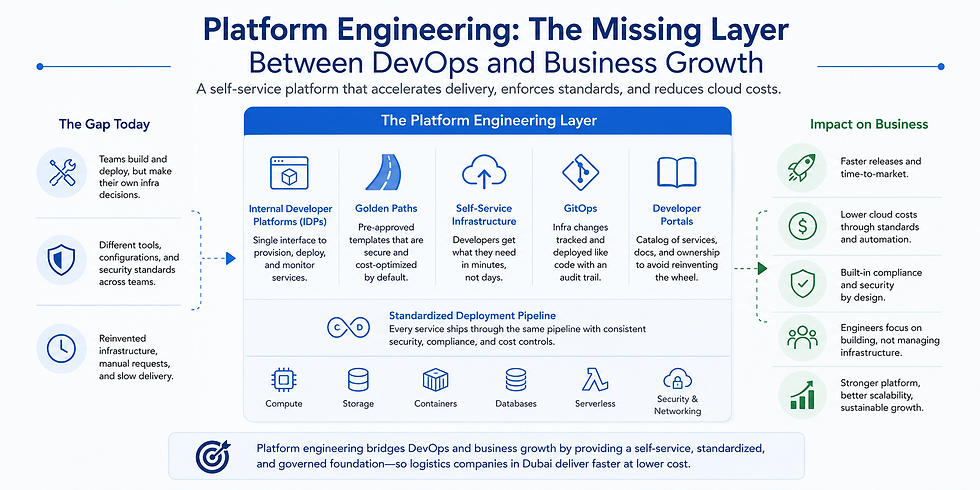
Platform Engineering: The Missing Layer Between DevOps and Business Growth
Most logistics companies in Dubai already have DevOps. Almost none of them have platform engineering, and that gap is where a lot of quiet cost and speed problems live.
DevOps got teams building and deploying faster than the old model of siloed dev and ops. But as logistics companies scale — adding warehouses, integrating new carrier APIs, launching customer-facing apps — every team ends up owning its own infrastructure decisions. One team picks its own CI/CD tool. Another configures its own security groups. A third builds a deployment pipeline that only one engineer fully understands. That's not a governance problem you can fix with a policy document; it's a structural one.
Platform engineering solves it by giving development teams a self-service layer instead of a rulebook. The core pieces:
Internal Developer Platforms (IDPs) — a single interface where developers provision infrastructure, deploy code, and monitor services without filing a ticket to a central ops team.
Golden paths — pre-approved, pre-configured templates for common tasks (spinning up a new microservice, deploying a serverless function) that are secure and cost-optimized by default.
Self-service infrastructure — developers get what they need in minutes, not days.
GitOps — infrastructure changes tracked and deployed the same way code is, with a clear audit trail.
Developer portals — a catalog of services, documentation, and ownership that keeps large engineering orgs from reinventing the wheel.
Standardized deployment — every service ships through the same pipeline, so cost and security assumptions don't vary team to team.
Done well, this is what makes effective platform engineering in dubai worth the investment for logistics companies specifically: fewer engineers reinventing infrastructure from scratch, faster releases because nobody's waiting on a manual provisioning request, and better compliance because governance is built into the golden path rather than enforced after the fact.
DevOps | Platform Engineering |
Team owns infrastructure | Platform team provides reusable platform |
Manual pipelines | Automated golden paths |
Higher operational effort | Self-service deployment |
Individual tooling | Standardized platform |
The payoff shows up in engineering costs, too. When five teams stop maintaining five separate pipelines and instead consume one shared platform, the hours previously spent on infrastructure babysitting go back into building features that actually move the business.
How Managed Cloud Services Help Logistics Organizations Control Long-Term Cloud Spending
Serverless and platform engineering fix the architecture. But someone still has to watch the infrastructure day to day — and that's where UAE logistics companies keep running into the same wall: a regional cloud talent shortage that makes it hard to hire and retain skilled cloud engineers, let alone a full FinOps function.
This is the gap managed cloud services close. A capable managed provider takes on:
24/7 monitoring — catching performance and cost anomalies before they become a Monday-morning surprise.
Cost optimization / FinOps — ongoing rightsizing, reserved instance planning, and spend forecasting instead of a one-time audit.
Cloud security — patching, access control, and threat monitoring handled continuously.
Performance tuning — keeping latency-sensitive systems like tracking APIs responsive as traffic grows.
Disaster recovery — tested failover plans, not just a backup policy sitting in a document.
Compliance — ongoing alignment with regulatory requirements as they evolve.
Continuous optimization — cost and performance reviews built into the operating rhythm, not an annual exercise.
For a logistics company running lean on internal cloud headcount, partnering with one of the established managed cloud service providers in dubai is often more realistic than trying to build a full-time FinOps and SRE function from scratch. It's not about outsourcing control — it's about getting continuous expert attention on cost and reliability instead of reactive firefighting when something breaks or a bill comes in high.
Building a Cost-Efficient Cloud Operating Model for Logistics
None of these three pieces works particularly well in isolation. Serverless without platform engineering just means developers reinventing event-driven patterns from scratch every time. Platform engineering without managed services means an internal team still has to own 24/7 monitoring on top of everything else. Managed services without a modern architecture underneath just means paying someone to babysit the same wasteful infrastructure.
Put together, they form a repeatable path:
Planning → Migration → Automation → Optimization → Continuous Improvement
Or, viewed as an architectural progression:
Traditional Cloud → Cloud Migration → Serverless → Platform Engineering → Managed Cloud Services → Continuous Cloud Optimization
A logistics software development company in Dubai that's been through this progression with multiple clients typically starts by identifying which workloads are event-driven and bursty (the serverless candidates), which are stable, always-on core systems, and which need dedicated compliance handling. From there, platform engineering standardizes how everything gets deployed, and managed services keep the whole system tuned over time rather than degrading back into waste within a year.
Compliance and Data Governance Considerations for UAE Logistics Companies
Cost optimization can't come at the expense of compliance, and for logistics companies handling customer shipment data, financial records, and cross-border trade documentation, that's not optional.
The UAE Personal Data Protection Law (PDPL) sets requirements around how personal data is collected, processed, and stored — including where it physically resides. That data residency requirement shapes cloud architecture decisions directly: workloads touching UAE customer data often need to stay in regional cloud availability zones rather than defaulting to whichever region is cheapest.
Beyond PDPL, a modern logistics cloud platform needs:
Zero Trust architecture — verifying every request rather than trusting anything inside the network perimeter by default.
Identity management — tightly scoped access controls so a warehouse system integration doesn't have blanket access to customer data.
Audit logging — a full record of who accessed what, when.
Encryption — at rest and in transit, without exception.
Disaster recovery and business continuity — plans that get tested, not just written.
ISO 27001 and SOC 2 alignment — the baseline enterprise customers and partners increasingly expect before they'll integrate with your systems.
Challenge | Recommended Cloud Strategy |
Data residency | Regional cloud deployment |
Compliance | Continuous monitoring |
Security | Zero Trust |
Cost | FinOps |
Scaling | Serverless |
Good news: none of this conflicts with cost optimization. Regional deployment, continuous monitoring, and FinOps discipline are the same practices that reduce waste in the first place.
Industry Trends Shaping Cloud Cost Optimization in UAE Logistics
A few forces are converging on logistics cloud strategy at once. AI-driven demand forecasting and predictive maintenance are pushing more compute-intensive workloads into the cloud, right as IoT sensors on containers and warehouse equipment generate a steady stream of telemetry needing real-time processing. Edge computing is starting to handle some of that closer to ports and warehouses, cutting latency and, in some cases, egress costs. Cloud-native design — built for elasticity from day one rather than retrofitted later — is becoming the default expectation for new logistics platforms, not a differentiator. The UAE's broader digital economy push is accelerating this shift, creating both the infrastructure incentives and the competitive pressure to modernize rather than simply migrate and stand still.
Signs Your Logistics Organization Needs a New Cloud Operating Strategy
A quick self-check. If more than a couple of these sound familiar, the underlying architecture — not just the budget — probably needs attention:
Cloud bills climbing month over month with no clear explanation
Software releases that take weeks instead of days
Infrastructure bottlenecks during peak shipping periods
Difficulty hiring or retaining cloud engineering talent
Deployments still handled manually by a small group of engineers
Growing compliance concerns as data residency rules tighten
Multiple disconnected cloud tools with no unified view of spend
Low utilization on provisioned infrastructure
Choosing the Right Cloud Modernization Partner in Dubai
Selecting the right cloud modernization partner is about much more than technical certifications. Logistics organizations operate complex, mission-critical systems that include real-time shipment tracking, customs integrations, warehouse automation, fleet telemetry, and high-volume data processing. A qualified partner should have proven experience delivering solutions for logistics and supply chain businesses rather than only general enterprise software projects. They should also demonstrate expertise in serverless architecture, enabling event-driven applications that scale efficiently while reducing infrastructure costs. Equally important is strong platform engineering capability, including the ability to build internal developer platforms, standardized deployment pipelines, and self-service environments that accelerate software delivery without compromising governance.
Beyond implementation, the right partner should provide comprehensive managed cloud services with 24/7 monitoring, proactive optimization, and continuous operational support instead of limited business-hours assistance. They should also have a strong understanding of UAE compliance requirements, including the Personal Data Protection Law (PDPL), while following globally recognized security frameworks such as ISO 27001 and SOC 2. Look for a provider that treats cloud cost optimization as an ongoing FinOps practice rather than a one-time exercise and follows a phased migration strategy that minimizes business disruption. Most importantly, they should be able to assess your existing cloud environment, identify areas of unnecessary spending, and present measurable opportunities to improve efficiency before recommending a modernization roadmap. That level of transparency helps ensure your investment delivers long-term scalability, stronger governance, and sustainable cost savings instead of simply replacing one infrastructure with another.
Why Choose SISGAIN Technologies for Cloud Modernization in Dubai?
At SISGAIN Technologies, we help logistics organizations modernize their cloud infrastructure with a practical, outcome-driven approach. Our expertise spans Serverless Architecture, Platform Engineering, and Managed Cloud Services, enabling businesses to reduce cloud costs, improve application performance, and accelerate software delivery without compromising security or compliance. Every solution is designed around your operational goals, whether you're managing fleet operations, warehouse automation, or real-time shipment tracking.
From cloud assessment and migration to continuous optimization, our team builds scalable cloud-native platforms that support long-term business growth. By combining automation, governance, and cost optimization best practices, we help Dubai logistics companies create resilient digital infrastructure that is ready for the next stage of innovation and operational excellence.

Conclusion
Cloud cost optimization for logistics in Dubai isn't about using less cloud. It's about using it differently. The companies actually bringing their cloud bills under control aren't the ones cutting workloads or freezing innovation — they're the ones rebuilding their operating model around serverless architecture, platform engineering, and managed cloud services, so that spend tracks actual usage instead of worst-case capacity planning.
Get that combination right, and the outcome isn't just a lower bill. It's faster releases, better resilience during peak shipping seasons, and an engineering team spending its time on the business instead of on infrastructure maintenance. If your cloud spend has been climbing steadily without a matching jump in capability, it's worth a hard look at whether your operating model — not your workload — is the actual cost driver.
FAQ
1. Why are cloud costs still increasing after migrating logistics applications?
Migration moves workloads off physical servers, but it doesn't fix how those workloads are architected or managed. Over-provisioned instances, always-on services that should be event-driven, and a lack of centralized cost governance all persist unless someone specifically addresses them — which is why companies that migrated years ago are often still watching bills climb.
2. Is serverless architecture suitable for enterprise logistics platforms?
For bursty, event-driven workloads — shipment tracking, warehouse automation triggers, API processing, IoT telemetry — yes, often dramatically so. Cold starts and vendor lock-in are legitimate concerns for latency-sensitive core systems, which is why most enterprise logistics platforms end up hybrid: serverless for event-driven components, traditional infrastructure for stable, high-throughput core systems.
3. How does platform engineering differ from DevOps for logistics companies?
DevOps is a practice — collaboration between development and operations to ship code faster. Platform engineering is a product — a self-service internal platform that development teams consume so they're not each rebuilding infrastructure decisions from scratch. Companies running multiple teams (warehouse systems, customer apps, partner integrations) see the biggest gains here.
4. Should logistics companies in Dubai outsource cloud operations through managed cloud services?
It depends on internal capacity more than company size. If hiring and retaining cloud engineers with FinOps, security, and SRE expertise is a struggle — true for most mid-sized logistics operators in the region — a managed services partner typically delivers more consistent monitoring and compliance coverage than a stretched internal team can sustain alone.
Sources: Flexera 2026 State of the Cloud Report flexera.com; Gartner MENA IT Spending Forecast, 2026 gartner.com.


Comments