Why Dubai Retailers Are Replacing Traditional E-Commerce With Mobile-First Omnichannel Apps in 2026

Key Takeaways
UAE retail has moved past "online vs. offline" — customers expect one connected experience across app, website, social, and physical store.
67% of UAE shoppers used mobile during their last purchase; 53.2% expect cross-channel features; 77% factor in payment options before choosing where to shop.
Traditional e-commerce runs on siloed inventory, data, and loyalty — omnichannel unifies all three in real time.
Mobile-first isn't responsive design shrunk down — it's built for thumbs and small screens from day one.
Omnichannel platforms rest on five pillars: customer data, inventory, payments, loyalty, and fulfillment.
Benefits are measurable: higher retention, better conversion rates, real-time inventory accuracy, stronger engagement, and lower operational overhead.
AI only works well on top of clean, connected data — a fragmented tech stack makes AI recommendations unreliable.
UAE-specific must-haves: Arabic/RTL support, VAT-ready invoicing, WhatsApp integration, and localized delivery workflows.
Transitioning is a 4-step process: audit systems → prioritize mobile → integrate platforms → measure and optimize.
Choosing a development partner comes down to data ownership, security testing, integration depth, and post-launch support — not just launch-day promises.
A shopper in Dubai Marina finds a handbag on Instagram, checks the price on the brand's app, tries it on at the Mall of the Emirates two days later, and finishes the purchase through WhatsApp when the store is out of her size. No single channel gets credit for that sale. That's the point.
Retail in the UAE stopped being "online vs. offline" a while ago. Customers move between Instagram, TikTok, Google, WhatsApp, and physical stores inside a single buying decision, and they expect every one of those touchpoints to know what happened on the last one. A website that only handles transactions, and an app that doesn't talk to the store's inventory, can't keep up with that behavior anymore.
This is the shift behind mobile-first omnichannel retail Dubai strategies: retailers rebuilding around one connected experience instead of a patchwork of separate channels. The numbers back up why this isn't optional. Roughly 67% of UAE shoppers used a mobile device during their most recent retail purchase, and 53.2% of consumers now expect cross-channel shopping features as standard, not a bonus. Payment flexibility matters just as much — 77% of shoppers factor in accepted payment methods before deciding where to buy.
Retailers who are still running separate online and in-store systems are watching customers abandon carts, repeat their preferences to a chatbot that has no memory of them, and lose loyalty points the moment they switch channels. This piece breaks down why that model is breaking, what's replacing it, and what a mobile-first omnichannel retail Dubai platform actually needs to include in 2026.
The UAE Retail Landscape Has Changed: Traditional E-Commerce Is No Longer Enough
Traditional e-commerce was built for a world where "online" and "in-store" were two separate businesses that happened to share a logo. That world is gone in the UAE, and the gap is showing.
How Traditional E-Commerce Works
Most legacy setups still run on this structure:
Separate systems for the website and the physical store, often built years apart
Customer data that lives in silos — the POS doesn't talk to the CRM, and neither talks to the app
Inventory tracked independently per channel, so "in stock online" and "in stock in-store" are two different, sometimes contradictory, answers
Loyalty programs that reset or fragment depending on where the customer shops
None of this was a mistake when it was built. It just wasn't designed for a customer who bounces between five touchpoints before buying anything.
Why Customer Expectations Have Changed in 2026
UAE consumers now default to mobile at nearly every stage of the buying journey — browsing, comparing, paying, and tracking delivery. Social commerce has matured past discovery; people complete purchases directly through Instagram checkout, TikTok Shop, and WhatsApp Business catalogs. And once a customer has experienced a brand that remembers their size, their last order, and their loyalty balance across channels, going back to a disconnected experience feels like a downgrade.
Traditional E-Commerce vs Omnichannel Retail
Here's the difference in practice, not theory:
Traditional E-Commerce | Omnichannel Retail |
Separate channels | Unified channels |
Independent inventory | Shared inventory |
Basic loyalty | Connected rewards |
Manual returns | Buy online, return in-store |
Responsive design | Mobile-first experiences |
The traditional ecommerce vs omnichannel retail comparison isn't about which one has a nicer app icon. It's about whether the systems behind the storefront actually share data in real time.

Why Mobile-First Design Is Driving the Future of Retail in Dubai
Mobile-first isn't a design trend retailers are chasing to look current. It's a response to where the money already is.
Mobile Commerce Has Become the Default Shopping Behavior
Product discovery starts on a phone. Comparison shopping happens on a phone, usually with three tabs open and a group chat running in the background. And when the moment to buy arrives, most UAE shoppers don't want to switch to a laptop — they want a one-click purchase inside the same app they were already browsing on.
Why Responsive Design Is Not the Same as Mobile-First Design
This distinction trips up a lot of retailers. A responsive website shrinks a desktop layout to fit a smaller screen. Mobile-first product development starts from the opposite direction: build the core experience for a thumb on a 6-inch screen first, then scale up. The difference shows up in load times, in how many taps it takes to check out, and in whether the app feels native or like a website wearing an app costume.
A Mobile-First Development Company Dubai retailers actually stick with will design the checkout flow, navigation, and product pages around mobile constraints from day one — not retrofit a desktop site after the fact.
The Essential Elements of Mobile-First Retail Apps
A retail app earns its place on someone's home screen when it gets these right:
Fast-loading product pages (every extra second of load time costs conversions)
Sticky add-to-cart buttons that stay visible while scrolling
Swipeable product galleries instead of static image grids
Guest checkout, because forcing account creation before purchase kills conversions
Wallet payments (Apple Pay, Samsung Pay, digital UAE wallets)
Live delivery tracking
Click-and-collect for customers who want the product today, not tomorrow
What Is an Omnichannel Retail App and Why Are Dubai Businesses Investing in It?
"Omnichannel" gets thrown around loosely enough that it's worth defining plainly.
Understanding Omnichannel Retail
Omnichannel commerce means every channel a customer touches — app, website, social media, physical store, WhatsApp — draws from the same customer profile, the same inventory, and the same loyalty ledger. It's different from multichannel retail, where a business simply exists on multiple platforms without connecting them. Unified commerce and cross-channel retail are close cousins of the same idea: one system of record, many entry points.
The Five Core Components of an Omnichannel Retail Platform
Customer data — a single profile that follows the shopper everywhere
Inventory — one real-time source of truth across every location and channel
Payments — consistent, flexible payment options regardless of where the transaction starts
Loyalty — rewards that accumulate and redeem the same way in-app, online, or in-store
Fulfillment — delivery, pickup, and returns that work interchangeably across channels
Real-World Customer Journey Example
Here's what a connected journey looks like end to end: a customer spots a product on Instagram, taps through to the product page, adds it to cart in the mobile app, picks up the order at a Dubai Mall store, earns loyalty points automatically, and later messages the brand on WhatsApp about an exchange — without repeating a single detail. That's not a hypothetical. It's the baseline experience retailers investing in omnichannel retail app development UAE are now building toward, because anything less feels broken to a customer who's used to better.
The Biggest Benefits of Omnichannel Retail for Dubai Businesses
The case for omnichannel isn't sentimental. It shows up in the numbers a retail operator actually tracks.
Higher Customer Retention
Personalized experiences — recommendations based on purchase history, loyalty perks tied to actual behavior — keep customers coming back instead of price-shopping a competitor every time. A connected loyalty program that works the same way online and in-store removes one of the biggest reasons customers drift away.
Improved Conversion Rates
Every extra step in checkout is a chance for someone to abandon the cart. Retailers who cut friction — saved payment details, guest checkout, one-tap reorders — see faster purchasing journeys and fewer drop-offs at the final step.
Better Inventory Visibility
Store-level inventory synced in real time means a customer never gets told an item is "in stock" only to find out at pickup that it isn't. It also means retailers stop over-ordering for one channel while another sits short.
Stronger Customer Engagement
Consistency across channels builds trust. A customer who gets a personalized WhatsApp message after browsing a product on the app, rather than a generic blast email, engages differently — because the brand is clearly paying attention.
Better Operational Efficiency
Integrated systems cut the manual reconciliation work that eats up staff time: matching online orders to in-store stock, updating loyalty balances by hand, chasing inventory counts across spreadsheets. Fewer disconnected systems mean fewer places for errors to creep in.

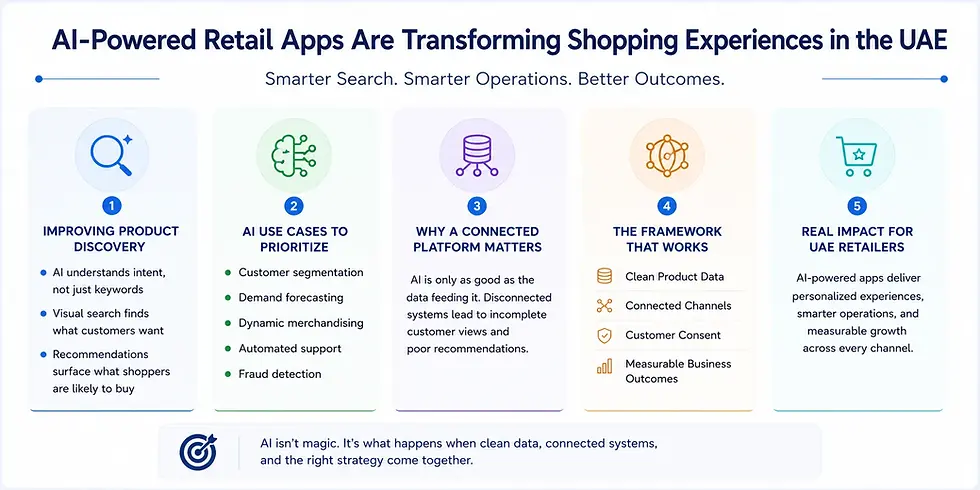
AI-Powered Retail Apps Are Transforming Shopping Experiences in the UAE
AI in retail has moved past the buzzword phase. UAE retailers are now using it for specific, measurable jobs.
How AI Is Improving Product Discovery
AI-powered search understands intent, not just exact keyword matches — so a search for "something for a beach wedding" returns relevant results instead of nothing. Visual search lets a customer photograph an item they liked and find it, or something close to it, in seconds. Recommendation engines then do the quieter work of surfacing products a shopper is actually likely to buy, based on real behavior rather than guesswork.
AI Use Cases That UAE Retailers Should Prioritize
Customer segmentation, so marketing spend targets the shoppers most likely to convert
Demand forecasting, to avoid both stockouts and overstock
Dynamic merchandising, adjusting what's shown based on real-time behavior
Automated customer support, handling routine questions instantly, day or night
Fraud detection, catching suspicious transactions before they become chargebacks
Why AI Requires a Connected Omnichannel Platform
AI is only as good as the data feeding it, and that's the part retailers often underestimate. The framework worth remembering:
Good Retail AI = Clean Product Data + Connected Channels + Customer Consent + Measurable Business Outcomes
An AI recommendation engine bolted onto a fragmented, disconnected tech stack will make bad recommendations, because it's working from an incomplete picture of the customer. AI-powered retail apps UAE businesses are betting on only work when the underlying platform is unified first.
Must-Have Features in a Mobile-First Omnichannel Retail App in 2026
A feature checklist worth building against, grouped by what it actually solves for.
Customer Experience Features
Smart search, product filtering, verified reviews, side-by-side product comparison, and wishlists that sync across devices — these are table stakes now, not differentiators. What separates a good app is how fast and intuitive they feel, not whether they exist at all.
Payment Features
Digital wallets, one-click checkout, securely saved cards, Buy Now Pay Later options, and biometric authentication for faster, safer logins. UAE shoppers are unusually sensitive to payment friction — recall that 77% weigh accepted payment methods before choosing where to shop at all.
Operations and Integration Features
This is the part customers never see but feel the absence of instantly: POS integration, ERP integration, CRM integration, warehouse integration, and analytics dashboards that give operators a real-time view of what's actually happening across the business.
UAE-Specific Requirements
A generic global app template doesn't cut it here. Retailers need Arabic and English language support built in from the start, full right-to-left (RTL) compatibility (not a bolted-on afterthought), VAT-ready invoicing that matches UAE tax requirements, native WhatsApp integration for support and order updates, and delivery workflows designed around how logistics actually work across the Emirates.
Getting this right usually takes more than a generic build. It's where Custom Product Design Services Dubai teams earn their keep — designing the UI, RTL layouts, and interaction patterns around how UAE shoppers actually behave, rather than translating a Western template and calling it localized.
How Dubai Retailers Can Successfully Transition From Traditional E-Commerce to Omnichannel Retail
Moving from a fragmented setup to a connected one doesn't happen in one leap. It happens in four deliberate steps.
Step 1: Audit Existing Systems
Start by mapping what actually exists today — POS, inventory management, ERP, CRM — and where the gaps and duplications sit. Most retailers are surprised by how much of their "system" is actually manual workarounds nobody wrote down.
Step 2: Prioritize the Mobile Experience
Rebuild around actual customer journeys, not internal org charts. That means rethinking checkout flow and overall user experience through the lens of someone shopping on a phone with one hand, standing in a queue.
Step 3: Integrate Business Systems
Sync inventory, connect payment systems, and unify delivery logistics so a customer's experience doesn't change depending on which "backend" happens to be handling their order.
Step 4: Measure and Optimize
Track conversion, retention, and engagement after launch — not just at launch. Omnichannel platforms generate far more usable data than fragmented systems ever could, and that data is wasted if nobody's watching it.
How to Choose the Right Retail App Development Partner in Dubai
This is where the decision moves from strategy to execution, and where the wrong choice gets expensive fast.
Questions Every Retailer Should Ask
Does the platform genuinely support Arabic and RTL, or is it an afterthought?
Can it integrate cleanly with existing POS and ERP systems?
Who owns the customer data once the platform is live — the retailer, or the vendor?
How are future upgrades handled, and at what cost?
What security testing is performed, and how often?
Is post-launch support included, or does it end at go-live?
A capable retail software development dubai partner should be able to answer every one of those without hedging. If they can't explain data ownership or security testing clearly, that's a warning sign worth taking seriously before signing anything.
Some retailers, particularly those planning to launch under their own brand quickly, look for a white label development partner Dubai businesses can build on without starting from a blank codebase — trading some customization for speed to market. That's a legitimate trade-off, as long as the retailer understands exactly what's being customized versus what's shared infrastructure.
Trust signals worth checking before committing: relevant retail sector experience (not just general app development), documented security practices, technology depth across POS/ERP/CRM integrations, and evidence of long-term support relationships with existing clients — not just launch-day case studies.
According to Visa's regional consumer research, UAE shoppers rank among the most mobile-centric, omnichannel-driven consumers globally, with a majority using smartphones at some point during nearly every retail journey, in-store or online. Separate industry data compiled by SAP's Emarsys research on omnichannel retail trends points to the same pattern worldwide: mobile has become the connective layer between digital discovery and physical shopping, not a side channel. Choosing a development partner who understands that shift — rather than one still thinking in terms of "a website and an app" — is the difference between a platform that lasts and one that needs replacing again in two years.

Conclusion
Dubai retailers aren't walking away from e-commerce. They're replacing disconnected digital channels with mobile-first platforms that connect customers, payments, inventory, fulfillment, loyalty, and AI into one system that behaves the same way no matter where a shopper enters it.
Retail in 2026 was never really about having an online store. It's about whether a customer's experience holds together across every channel they use — and whether the systems behind the scenes can actually keep up with how people shop now.
Frequently Asked Questions
What is mobile-first omnichannel retail?
It's a retail approach where the mobile app is built as the primary experience — not a scaled-down version of a website — and every channel (app, web, social, in-store) draws from the same customer, inventory, and loyalty data in real time.
What is the difference between traditional e-commerce and omnichannel retail?
Traditional e-commerce runs online and offline as separate systems with independent inventory and loyalty programs. Omnichannel retail unifies those systems so customer data, stock levels, and rewards stay consistent no matter which channel someone uses.
Why does mobile-first design matter for UAE retailers?
Because the majority of UAE shoppers now use a mobile device at some point during their purchase journey, and expect fast, native-feeling app experiences rather than a shrunk-down desktop website.
What features should a retail app include in Dubai?
At minimum: smart search, flexible payment options including digital wallets and BNPL, POS/ERP/CRM integration, Arabic and RTL support, VAT-ready invoicing, and WhatsApp integration for support and updates.
How much does omnichannel retail app development cost in the UAE?
Costs vary widely based on scope — a white-label starting point costs less than a fully custom build, and the final number depends on integrations, AI features, and the number of platforms (iOS, Android, web) involved. A platform assessment is the fastest way to get an accurate estimate.
How can AI improve retail apps in the UAE?
AI improves product discovery through smarter search and recommendations, helps forecast demand to avoid stockouts, powers 24/7 automated customer support, and flags fraudulent transactions — but only when it's built on clean, connected data across every channel.


Comments