Why Aviation Companies Are Choosing Dedicated Development Teams to Accelerate Digital Transformation in 2026
Updated: Aug 7

Key Takeaways
Aviation companies are adopting dedicated development teams to accelerate digital transformation and overcome talent shortages.
AI, cloud, cybersecurity, biometrics, and data integration are shaping aviation software development trends in 2026.
Legacy systems and fragmented data remain major challenges for aviation modernization.
Dedicated teams provide better control, scalability, compliance support, and long-term product ownership.
White label aviation software development helps startups and vendors launch aviation products faster.
UAE aviation growth is increasing demand for specialized technology partners and aviation IT outsourcing UAE solutions.
Choosing the right partner requires aviation expertise, security knowledge, integration skills, and ongoing support.
Airlines rarely lose passengers because a plane is late. They lose them because the check-in app crashed, a gate change never reached their phone, or a baggage system couldn't talk to the crew-scheduling tool. None of that is a flying problem — it's a software problem, and in 2026, software is moving faster than most aviation IT departments can hire for.
That gap is why dedicated development teams for aviation have gone from a niche staffing option to the default delivery model for airlines, airports, MRO providers, and aviation startups alike. Traditional outsourcing — hand off a spec, wait for delivery, hope it integrates — was built for a slower era. It doesn't hold up against real-time flight data, AI-driven operations, and compliance frameworks rewritten every year.
Dubai is a good lens for this shift. DXB moved 95.2 million passengers in 2025, up 3.1% year-on-year, with 2026 traffic forecast to approach 99.5 million, according to Dubai Airports' own reporting. Growth at that scale forces every system behind the scenes — baggage, biometrics, crew rostering, cargo — to modernize at the same pace, a core reason aviation digital transformation Dubai is racing ahead of most other aviation hubs.
This piece covers how aviation digital transformation is unfolding in 2026, the technology gaps slowing airlines and airports down, why dedicated development teams for aviation are winning over legacy outsourcing, where white label aviation software development fits in, and how to evaluate a partner.
The State of Aviation Digital Transformation in 2026
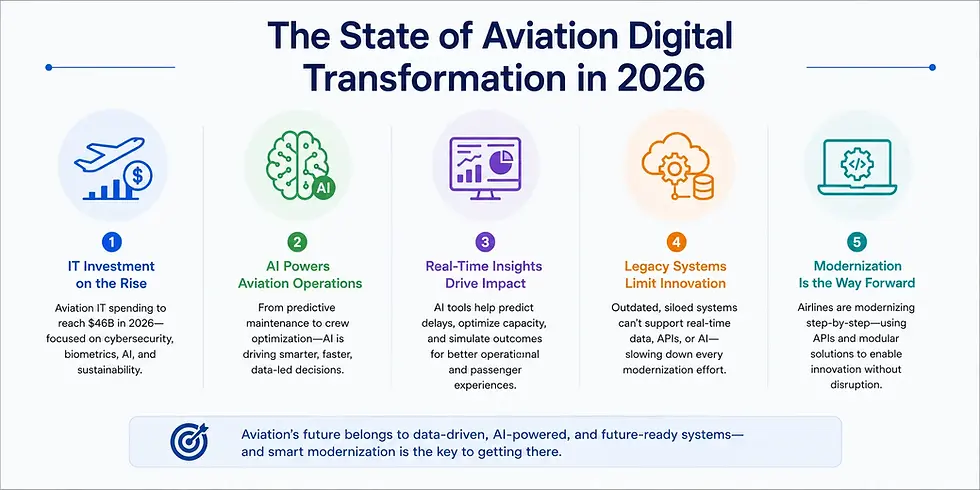
Aviation IT budgets aren't just growing — they're growing with intent. Research from SITA puts the industry on pace to spend close to $46 billion on IT by 2026, split roughly between $37 billion from airlines and $9 billion from airports, concentrated on cybersecurity, biometrics, AI, and sustainability — a clear signal of where aviation software development trends are heading through 2026.
AI Is Becoming the Backbone of Aviation Operations
Predictive maintenance is the easiest example. Instead of servicing an engine on a fixed calendar, airlines now feed sensor data into models that flag wear before it turns into a delay — fewer aircraft-on-ground events, less downtime, maintenance crews working from data instead of guesswork.
The same logic is spreading everywhere: crew optimization tools balance duty-time rules against staffing costs in real time, passenger analytics platforms predict no-show rates and adjust overbooking on the fly, and digital twins let airports test a terminal redesign before a single wall gets built. This isn't experimental anymore — it's operational. SITA's latest figures show 83% of airlines already use AI for operational decisions and passenger services, with 51% using it specifically to predict delays and disruption.
Why Legacy Aviation Systems Are Slowing Innovation
Here's the catch: most of that AI ambition is running straight into infrastructure built two decades ago. Airline reservation systems, MRO platforms, and airport operational databases were designed for batch processing, not live data streams. They sit in silos, don't expose modern APIs, and were never built to feed a machine learning pipeline.
Modernizing them is expensive and risky precisely because they're mission-critical — you can't take a crew-scheduling system offline for a rewrite the way you might a marketing site. Most internal teams know the legacy stack is holding back every AI initiative on the roadmap but lack the bandwidth to modernize it without disrupting live operations, which is why current aviation software development trends favor incremental modernization — wrapping legacy cores in modern APIs — over full rip-and-replace projects.
The Biggest Technology Challenges Aviation Companies Face Today
Strip away the buzzwords and three problems keep surfacing in almost every conversation with an aviation CIO: fragmented data, compliance complexity, and a shrinking talent pool.
Fragmented Data Across Aviation Systems
An airport's Airport Operational Database doesn't naturally talk to ACARS messaging, which doesn't naturally talk to MRO scheduling software, which doesn't naturally talk to IoT sensors or the passenger-facing app. Each system was bought separately, from different vendors, on different data models, so the AI initiatives above have nothing clean to learn from. Closing that gap is one of the clearest aviation software market gaps 2026 that dedicated development teams for aviation are increasingly brought in to solve.
Cybersecurity and Compliance Are More Complex Than Ever
Aviation software doesn't just need to work — it needs to pass audits most consumer software teams never encounter. DO-178C governs software used in airborne systems; DO-326A sets the airworthiness security process for anything network-connected. Zero Trust architecture is becoming the default expectation, and software bills of materials are increasingly required so regulators can trace every dependency back to its origin — now baked into mainstream aviation software development trends rather than treated as a specialist add-on.
That's not a checklist a generalist shop can pick up on the job. It's why cybersecurity now tops aviation IT budgets: 66% of airlines and 73% of airports name it their primary concern. Closing that gap without a specialized partner is one of the harder aviation software market gaps 2026 leaves unsolved for most in-house teams.
Finding Aviation Software Talent Is Becoming Harder
AI engineers who also understand FAA or GCAA compliance are rare. Cloud engineers who've actually migrated an airline reservation system are rarer still. Add compliance specialists and aviation solution architects to the list, and most internal hiring plans stall before the interview stage — the overlap between aviation domain knowledge and modern engineering skill is a small pool globally, and every airline and airport is fishing in it at once.
That talent crunch is a direct driver behind the growth in aviation IT outsourcing UAE-based companies are turning to. Rather than compete for the same handful of specialists everyone wants, aviation businesses are partnering with providers who already have that talent assembled — the same reason dedicated development teams for aviation keep coming up as the default answer rather than a fallback option.
Why Dedicated Development Teams Are Becoming the Preferred Delivery Model
A dedicated development team isn't a freelancer roster or a project-based vendor. It's a group of engineers, QA specialists, and often a project lead who work exclusively on your product, embedded in your workflows and priorities — but employed and managed by the technology partner. You get in-house control without the twelve-month hiring cycle, which is why this model sits at the center of aviation software development trends heading into 2026.
For aviation specifically, dedicated development teams solve problems traditional outsourcing structurally can't.
Faster Delivery, Backed by Domain Experts
Because the team is dedicated rather than shared across multiple clients, there's no queueing. A crew-scheduling feature that would sit in a generalist agency's backlog for six weeks can move the same day, since the team isn't context-switching between unrelated projects. That speed pairs with something harder to buy on short notice: dedicated development teams for aviation typically arrive already fluent in PNR structures, IATA messaging standards, and the operational realities of an airport ops center.
Easier Compliance, Flexible Scaling
Teams that specialize in aviation build DO-178C and DO-326A awareness into their default engineering process, not as an afterthought bolted on before an audit. That matters when a regulator asks for traceability documentation the team can produce because it was maintained from day one. The same teams also scale with the roadmap rather than a fixed headcount — an airport preparing for a terminal expansion needs extra engineers for the build-out, then a smaller maintenance crew afterward, and a dedicated model flexes both ways.
Better Integration with Existing Aviation Systems
Whether it's a cargo operator connecting a new tracking platform to a customs system, or an MRO provider linking predictive maintenance software to a decades-old ERP, teams that have done this category of integration before move faster because they've already solved a version of the same problem elsewhere.
Put together, these factors explain why dedicated development teams for aviation are showing up in more RFPs than traditional staff-augmentation contracts. Airlines want speed and domain depth in the same package, and that's increasingly the only model that delivers both.

Dedicated Development Teams vs Traditional IT Outsourcing
The difference between these two models goes beyond pricing. Traditional outsourcing may appear cheaper initially, but costs often increase due to change requests, re-scoping, and repeated onboarding. Dedicated development teams for aviation offer a predictable monthly model with the flexibility to adjust priorities without major disruptions.
Control is another key advantage. With a dedicated team, aviation companies can directly manage sprints, adapt to regulatory changes, and maintain better communication. Over time, the team gains deep knowledge of the codebase, business processes, and compliance requirements.
For aviation software, where systems often operate for years, knowledge retention is critical. Dedicated teams preserve technical expertise and support long-term improvements, audits, and modernization efforts.
Unlike traditional outsourcing, which focuses on completing a project, dedicated teams support continuous innovation and scalability. This shift is driving the growth of aviation IT outsourcing UAE companies and shaping modern aviation software development trends.
Where White Label Aviation Software Development Fits In
Dedicated teams aren't the only model worth knowing. White label aviation software development solves a different problem: it's for companies that need to sell a finished product under their own brand without building the underlying engineering from scratch.
Best Use Cases
Aviation startups building a passenger app or crew-management SaaS product often don't have years to spend on core engineering before going to market — they need a proven foundation to brand and launch fast. Airport technology vendors selling flight-information displays or self-service kiosks across multiple clients face a similar calculus, and system integrators bidding on government contracts often need components they can license and assemble rather than build from zero.
SaaS providers entering aviation from an adjacent industry, logistics or hospitality for example, often license a white label aviation software development foundation instead of spending two years learning the domain the hard way — a pattern increasingly true of companies searching specifically for white label development services Dubai providers can deliver, given how fast the local aviation vendor ecosystem is expanding around DXB and DWC.
Dedicated Teams vs White Label Development
The two aren't competitors; they answer different questions. Need a fully custom platform that reflects your specific operational workflows? A dedicated team is the right call, since architectural ownership stays with you. Need to launch fast on a proven, already-compliant core you can brand and customize at the edges? White label aviation software development gets you to market in a fraction of the time. Plenty of businesses use both — launching on a white-label foundation, then moving to a dedicated team once the product outgrows what an off-the-shelf platform can offer.

Why UAE Aviation Companies Are Investing in Dedicated Teams
Dubai's Aviation Growth Is Creating Huge Software Demand
The numbers behind aviation digital transformation Dubai make the case better than any pitch deck could. DXB handled a record 95.2 million passengers in 2025, with Dubai Airports forecasting 99.5 million in 2026. Dubai World Central is being expanded with a $35 billion investment that will eventually let it handle 260 million passengers and 12 million tonnes of cargo annually. Every additional passenger and cargo tonne runs through booking systems, baggage software, customs integrations, and smart-airport infrastructure someone has to build, test, and maintain.
That growth is tightly linked to the wider Dubai Economic Agenda (D33), which positions the emirate as a global logistics hub — the clearest local expression of aviation digital transformation Dubai is currently pursuing at scale. Every smart-airport initiative tied to that agenda — biometric boarding, automated cargo handling, predictive terminal management — needs software teams that understand both the technology and the aviation-specific compliance layer around it. Airports and airlines building that infrastructure are increasingly looking for airport systems developers in Dubai who've already shipped comparable platforms elsewhere.
Why Aviation IT Outsourcing Is Growing in UAE
Local hiring in UAE aviation tech is competitive — the same small pool of AI engineers, cloud architects, and compliance specialists is being recruited by airlines, airports, and startups at once. Nearshore collaboration, especially with India-based engineering talent, has become a practical answer, and it's a core reason aviation IT outsourcing UAE demand keeps rising as aviation digital transformation Dubai accelerates.
Time-to-market pressure adds to this. With DXB posting record daily traffic and airlines racing to deploy biometric ID management, waiting six months to hire and onboard an internal team isn't realistic. Businesses that want to hire dedicated developers Dubai operations can rely on choose that route because it collapses the gap between "we need this built" and "engineers are writing code" from months to weeks. Arabic localization needs — for passenger apps, kiosk interfaces, and government systems — add another layer specialized teams handle better than a generic offshore vendor, one more reason aviation IT outsourcing UAE has grown so quickly.
How to Choose the Right Dedicated Development Partner for Aviation Projects
Not every team claiming aviation expertise truly understands the industry. With growing aviation IT outsourcing UAE demand, companies need partners with proven aviation experience, not just generic software skills.
Start by evaluating domain expertise. Look for experience with aviation systems, IATA standards, operational workflows, and compliance requirements. Security expertise is equally important — ask about hands-on experience with standards like DO-178C and DO-326A.
Integration capabilities should be a top priority, as aviation platforms often need to connect with legacy systems like AODB, ERP, MRO, and real-time data platforms. A partner with previous integration experience can reduce risks and accelerate delivery.
Finally, choose a team that offers long-term support. Aviation software requires continuous improvement, and a reliable partner should maintain the technical knowledge needed for future upgrades and operational challenges.
Why SISGAIN Technologies Is the Right Technology Partner for Aviation Digital Transformation
SISGAIN Technologies builds dedicated aviation software teams around engineers who already understand the operational and regulatory weight of the industry, not generalists learning aviation on a client's timeline — AI capability for predictive maintenance and passenger analytics, cloud-native architecture built to scale with traffic growth, and integration experience connecting new platforms to the legacy systems most airlines and airports still run.
The team works across both custom development and white-label delivery, depending on whether a client needs a fully bespoke platform or a proven foundation to brand and launch quickly. With direct experience in the UAE market and an agile delivery process built for long-term product ownership, SISGAIN is built to support aviation businesses well past launch day.
Conclusion
Aviation software isn't getting simpler. Between AI adoption, tightening cybersecurity requirements, and passenger volumes breaking records month after month, the systems running airlines, airports, and MRO operations have to do more, faster, with less room for error than two years ago. Internal hiring alone can't keep pace — the specialized talent aviation software demands is too scarce for any single company to build a full bench in-house.
Dedicated development teams reduce the risk of a stalled modernization project, shorten the time between deciding to build something and shipping it, and give aviation businesses the continuity long-lived, safety-critical software actually needs. The organizations moving on this now, rather than waiting for the next budget cycle, are best positioned to capitalize on emerging aviation software development trends and close the aviation software market gaps 2026 that are still wide open across the industry.
If you're weighing how to modernize a platform, launch a new product, or simply keep pace with everything above, it's worth having a direct conversation about what a dedicated aviation development team could take off your plate.
FAQs
Why are aviation companies choosing dedicated development teams instead of traditional outsourcing?
Dedicated development teams provide better control, faster communication, domain expertise, and long-term collaboration, helping aviation companies manage complex software projects, compliance needs, and continuous digital transformation more effectively.
How can dedicated development teams help aviation digital transformation?
Dedicated teams help aviation businesses modernize legacy systems, integrate APIs, implement AI solutions, improve operational efficiency, and build scalable platforms aligned with evolving aviation technology requirements.
What should aviation companies look for in a software development partner?
Aviation companies should evaluate domain experience, security expertise, compliance knowledge, system integration capabilities, and long-term support to ensure reliable and scalable aviation software development.
Is white label aviation software development suitable for aviation startups?
Yes, white label aviation software development helps startups launch products faster by using ready expertise, reducing development costs, and allowing them to focus on customers while experts handle technology execution.


Comments