How Cloud-Native Infrastructure Is Supporting Logistics Transformation

Key Takeaways
Cloud-native infrastructure for logistics provides the scalability, flexibility, and resilience needed to support modern supply chain operations.
Legacy on-premise systems often struggle with growing shipment volumes, real-time visibility, and integration with emerging technologies.
Cloud-based logistics solutions help businesses improve operational efficiency, reduce infrastructure costs, and accelerate software innovation.
Technologies such as AI, IoT, machine learning, Kubernetes, microservices, and serverless computing become more effective when built on cloud-native platforms.
Modern cloud architectures improve collaboration, disaster recovery, supply chain visibility, and business continuity.
A phased cloud adoption strategy, supported by strong security and scalable architecture, reduces migration risks and maximizes long-term value.
As logistics technology transformation continues, organizations investing in cloud-native platforms today will be better prepared for autonomous operations, predictive decision-making, and future supply chain challenges.
The logistics industry is changing rapidly as businesses face rising shipment volumes, growing customer expectations, and increasingly complex supply chains. Real-time tracking, faster deliveries, and operational efficiency have become essential, making it difficult for traditional infrastructure to keep up with modern logistics demands.
To remain competitive, organizations are embracing logistics technology transformation by adopting solutions that offer greater flexibility, scalability, and resilience. Among these, cloud-native infrastructure for logistics has emerged as a key enabler, allowing businesses to modernize operations, integrate systems seamlessly, and respond quickly to changing market conditions.
In this article, we'll explore how cloud-native infrastructure is transforming logistics, why legacy systems are falling behind, the technologies driving this shift, and the business benefits organizations can achieve by adopting modern cloud-based approaches.
Logistics Is Evolving Faster Than Traditional Infrastructure Can Support
The logistics industry is growing rapidly, driven by global trade, expanding eCommerce, and increasingly complex supply chains. Customers now expect real-time tracking, faster deliveries, and seamless order fulfillment across multiple sales channels. Meeting these expectations requires logistics businesses to operate with greater speed, accuracy, and flexibility than ever before.
However, many organizations still rely on legacy on-premise systems that struggle to keep up with rising demand. These systems are often difficult to scale, costly to maintain, and unable to integrate efficiently with modern technologies, creating operational bottlenecks and limiting business agility.
As a result, logistics technology transformation has become a top priority. By adopting cloud-native infrastructure for logistics, businesses can build scalable, resilient, and adaptable operations that are better equipped to handle changing market demands and future growth.
Understanding Cloud-Native Infrastructure in Modern Logistics
Cloud-native infrastructure is a modern approach to building applications that are designed specifically for the cloud. Unlike traditional cloud hosting, which simply moves existing software to cloud servers, cloud-native infrastructure for logistics uses technologies that enable automatic scaling, continuous updates, and greater flexibility. This helps logistics platforms remain reliable even during changing workloads.
The foundation of cloud-native architecture includes containers, Kubernetes, microservices, APIs, serverless computing, and DevOps automation. Together, these technologies allow different parts of a logistics application to operate independently, making it easier to deploy updates, integrate business systems, and improve performance without disrupting daily operations.
This modular design enables logistics companies to innovate faster while maintaining system stability. Many organizations also work with providers offering managed cloud services in dubai to simplify infrastructure management and ensure consistent platform performance. As operations continue to grow in complexity, more businesses are adopting cloud solutions for logistics to improve scalability, strengthen integrations, and support long-term digital transformation.
Why Traditional Logistics Systems Are Holding Businesses Back
Many logistics businesses still depend on systems that were built for a different business environment. While these platforms may have supported operations for years, they often struggle to meet today's demands for speed, flexibility, and real-time decision-making. As supply chains become more dynamic, the limitations of legacy infrastructure become increasingly apparent.
Limited Scalability During Demand Surges
Logistics demand is rarely consistent throughout the year. Seasonal shopping events, promotional campaigns, and unexpected market shifts can cause sudden spikes in shipment volumes. Traditional infrastructure often requires manual hardware upgrades or additional servers to handle these peaks, making it difficult to scale quickly. This can result in slower processing, delayed deliveries, and reduced customer satisfaction.
Data Silos Across Warehousing, Fleet, and Inventory
Many legacy systems operate independently, with warehouse management, fleet operations, inventory control, and order management using separate databases. These disconnected systems create data silos that make it difficult to access accurate, up-to-date information. Teams spend valuable time reconciling data instead of making informed operational decisions.
Slow Software Updates and High Maintenance Costs
On-premise systems typically require scheduled maintenance, lengthy upgrade cycles, and significant IT resources. Even small software improvements may involve downtime or complex testing processes. Over time, maintaining aging infrastructure becomes costly while delaying access to new capabilities that could improve operations.
Lack of Real-Time Visibility Across Operations
Modern logistics depends on instant access to shipment status, inventory levels, and transportation performance. Legacy platforms often process information in batches or rely on delayed reporting, preventing businesses from responding quickly to disruptions. Without real-time visibility, decision-making becomes reactive instead of proactive.
Difficulty Integrating Modern Technologies
Emerging technologies such as AI-powered forecasting, IoT tracking devices, predictive analytics, and automation require flexible integration capabilities. Older systems were not designed for these technologies, making integration expensive and technically challenging.
These challenges are encouraging organizations to modernize their infrastructure. As businesses look for greater flexibility, scalability, and operational efficiency, many are investing in cloud-based logistics solutions that support continuous innovation and long-term growth.

How Cloud-Native Infrastructure Is Powering Logistics Technology Transformation
Cloud-native technologies are changing how logistics companies build, manage, and optimize their operations. Instead of relying on rigid infrastructure, organizations can create flexible digital ecosystems that adapt to changing business requirements. This shift is accelerating logistics technology transformation across the supply chain.
Elastic Scalability for Seasonal Logistics Demand
Logistics workloads constantly fluctuate. Holiday shopping seasons, large promotional campaigns, and unexpected market demand can significantly increase shipping volumes within a short period.
Cloud-native platforms automatically allocate additional computing resources whenever demand rises and reduce them once workloads return to normal. This elasticity allows businesses to maintain consistent performance without investing in excess infrastructure.
Real-Time Data Synchronization Across Supply Chains
Supply chains generate data from multiple sources, including warehouses, transportation systems, inventory platforms, suppliers, and customers. Modern cloud-based logistics solutions synchronize this information in real time, enabling faster decision-making and better operational visibility.
Traditional applications often require the entire system to be updated whenever a single feature changes. Cloud-native applications use microservices, allowing individual components to be developed and deployed independently. This accelerates innovation while minimizing operational downtime.
Seamless Integration with ERP, WMS, and TMS Platforms
Modern cloud solutions for logistics simplify integration between ERP, WMS, TMS, and other business systems through APIs. This improves data flow, reduces manual work, and enhances collaboration across the supply chain.
Cloud-native environments also strengthen disaster recovery through automated backups and failover capabilities. Even during infrastructure failures, operations can continue with minimal disruption while protecting critical business data.
Improved Operational Agility
Businesses need technology that can quickly adapt to changing customer expectations and market conditions. Cloud-native platforms make it easier to launch new services, integrate emerging technologies, and optimize workflows without rebuilding the entire IT environment. This flexibility drives ongoing logistics technology transformation, helping organizations stay competitive while supporting sustainable long-term growth.
Emerging Technologies That Work Best with Cloud-Native Logistics Platforms
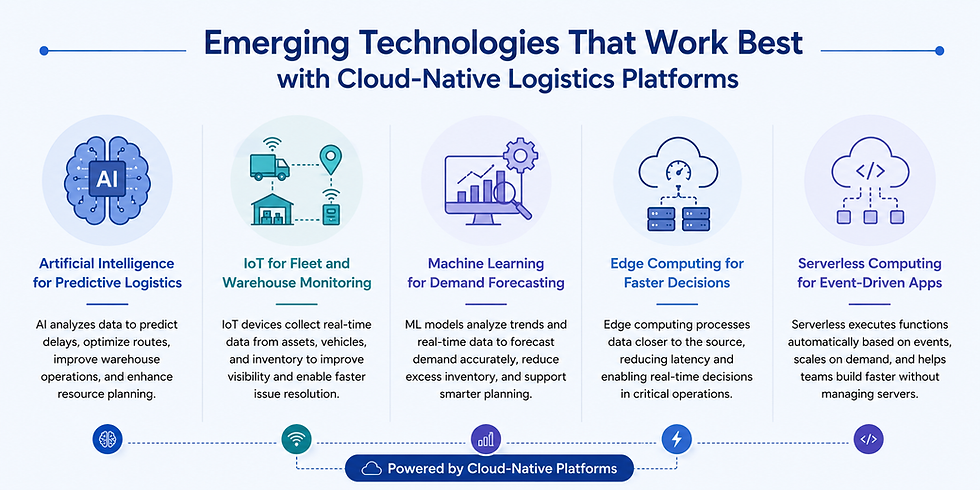
Cloud-native platforms provide the flexibility needed to adopt emerging technologies without rebuilding existing systems. As logistics operations become increasingly data-driven, these technologies help businesses improve efficiency, automate decision-making, and respond more quickly to changing conditions.
Artificial Intelligence for Predictive Logistics
Artificial Intelligence (AI) enables logistics companies to analyze large volumes of operational data and identify patterns that would be difficult to detect manually. AI can predict delivery delays, recommend better transportation routes, optimize warehouse operations, and improve resource planning. With cloud-native platforms, AI models can continuously process fresh data and deliver more accurate insights over time.
IoT for Fleet and Warehouse Monitoring
Internet of Things (IoT) devices collect real-time information from vehicles, warehouses, and shipping containers. Sensors can monitor vehicle location, fuel usage, equipment health, temperature, and inventory movement throughout the supply chain. Cloud-native infrastructure allows this information to be processed instantly, giving logistics teams better visibility and enabling faster responses to operational issues before they become costly problems.
Machine Learning for Demand Forecasting
Demand forecasting becomes more accurate when businesses combine historical trends with real-time operational data. Machine learning models can identify seasonal buying patterns, regional demand fluctuations, and inventory requirements with greater precision. Businesses investing in Machine Learning Development Services in Dubai can build predictive models that improve forecasting accuracy and support smarter planning decisions. This helps organizations reduce excess inventory, improve warehouse utilization, and maintain optimal stock levels while supporting more informed business planning.
Edge Computing for Faster Operational Decisions
Certain logistics decisions must be made immediately, especially in transportation and warehouse environments where delays can affect delivery performance. Edge computing processes data closer to where it is generated instead of sending every request to a centralized cloud environment. This reduces latency and enables faster operational decisions, particularly for autonomous equipment, warehouse automation, and connected fleet management.
Serverless Computing for Event-Driven Logistics Applications
Many logistics processes are event-driven. A shipment status changes, a delivery is completed, inventory reaches a threshold, or a customer requests a tracking update. Serverless computing automatically executes specific functions whenever these events occur, eliminating the need to manage dedicated servers.
Services such as aws lambda development services in dubai demonstrate how event-driven architectures can efficiently process thousands of operational events while automatically scaling based on demand. This approach improves responsiveness, reduces infrastructure overhead, and allows development teams to focus on building business functionality instead of managing servers.
Together, these technologies strengthen cloud-native logistics platforms by making operations more intelligent, responsive, and scalable as business requirements continue to evolve.
Business Benefits of Cloud-Based Logistics Solutions
Adopting cloud-based logistics solutions helps businesses improve efficiency while preparing for long-term growth. By reducing reliance on physical infrastructure, organizations can lower IT costs, scale resources as needed, and introduce new features much faster without lengthy deployment cycles.
Cloud-native platforms also enhance customer experiences by enabling real-time shipment tracking, faster issue resolution, and more reliable deliveries. Built-in security, disaster recovery, and compliance capabilities improve operational resilience while helping businesses protect critical data and maintain uninterrupted services.
In addition, cloud-based systems improve collaboration by connecting warehouses, fleets, suppliers, and business teams through shared real-time data. This increased visibility allows organizations to make faster decisions, optimize supply chain operations, and respond more effectively to changing market demands.

Best Practices for Successfully Adopting Cloud Solutions for Logistics
Moving to the cloud is not simply a technology upgrade. A successful transition requires careful planning, the right architecture, and a long-term strategy that supports business objectives. Organizations that take a structured approach are more likely to achieve better performance, stronger security, and higher returns on their investment.
Assess Existing Infrastructure
The first step is understanding the current technology landscape. Businesses should evaluate existing applications, infrastructure, integrations, and operational workflows to identify performance bottlenecks and modernization opportunities. This assessment helps determine which systems can be migrated directly and which require redesign before moving to the cloud.
Prioritize Security and Compliance
Logistics companies handle sensitive business information, customer records, shipment details, and financial data. Security should be incorporated into every stage of cloud adoption rather than treated as an afterthought. Strong identity management, encryption, continuous monitoring, and compliance with industry regulations help reduce risks while maintaining customer trust.
Choose a Scalable Cloud Architecture
Future business growth should be considered from the beginning. A scalable architecture allows organizations to accommodate increasing shipment volumes, new business locations, and additional digital services without major infrastructure changes. Selecting flexible cloud technologies ensures the platform can continue evolving alongside business needs.
Modernize Legacy Applications Gradually
Replacing every system at once can introduce unnecessary complexity and operational risk. Many organizations achieve better results by modernizing applications in phases. This approach allows critical business operations to continue while new cloud-native capabilities are introduced step by step, reducing disruption throughout the transition.
Invest in Cloud Platform Engineering
Long-term success depends on building a reliable cloud foundation that supports automation, scalability, and continuous improvement. Working with specialists in cloud platform engineering in dubai helps organizations design resilient architectures that align with business objectives. Many businesses also rely on managed cloud services in dubai to simplify infrastructure management, strengthen security, and ensure ongoing platform performance as operations continue to grow.

The Future of Logistics Technology Transformation
The next phase of logistics technology transformation will be driven by intelligent, connected, and highly automated digital ecosystems. As cloud-native platforms continue to evolve, logistics organizations will be able to make faster decisions while reducing operational complexity across the supply chain.
Autonomous supply chains will increasingly automate planning, inventory management, transportation scheduling, and order fulfillment with minimal manual intervention. AI-driven logistics orchestration will continuously analyze operational data to optimize routes, allocate resources, and respond instantly to disruptions.
Digital twins will provide virtual representations of warehouses, fleets, and distribution networks, allowing businesses to simulate different scenarios before making operational changes. Combined with hyperautomation, organizations will automate repetitive workflows across multiple business systems, improving efficiency while reducing human error.
Cloud optimization will also support more sustainable logistics by improving resource utilization, reducing unnecessary infrastructure consumption, and enabling smarter transportation planning. At the same time, predictive operations powered by advanced analytics will help businesses identify potential disruptions before they affect customers.
As these technologies mature, intelligent decision-making will become a defining advantage for logistics organizations. Businesses looking to accelerate this transition often collaborate with a Logistics Software Development Company in Dubai to build scalable, cloud-native solutions that support future-ready supply chains. This approach helps organizations adapt to evolving market demands while maintaining long-term operational resilience.
Why Choose SISGAIN Technologies for Cloud-Native Logistics Solutions?
Modernizing logistics infrastructure requires more than cloud migration—it demands a technology partner that understands both cloud-native architecture and the operational challenges of the logistics industry. SISGAIN Technologies helps businesses build scalable, secure, and future-ready logistics platforms that support long-term digital transformation.
From cloud-native application development and platform engineering to API integrations, microservices, Kubernetes, and serverless architectures, our team develops solutions that improve operational efficiency and simplify complex logistics workflows. We focus on building reliable systems that enable real-time visibility, seamless scalability, and continuous innovation.
Whether you're modernizing legacy applications or building a new logistics platform from the ground up, SISGAIN delivers tailored solutions that align with your business goals. Our expertise in cloud technologies helps organizations create resilient logistics ecosystems that are prepared for evolving customer expectations and future supply chain demands.

Conclusion
The logistics industry is entering a new era where flexibility, speed, and data-driven decision-making are essential for long-term success. Traditional infrastructure is no longer capable of supporting the growing demands of modern supply chains. Cloud-native infrastructure provides the scalability, resilience, real-time visibility, automation, and continuous innovation that logistics businesses need to remain competitive in an increasingly dynamic market.
As technologies such as AI, IoT, machine learning, and serverless computing continue to evolve, organizations with modern cloud foundations will be better equipped to improve operational efficiency, enhance customer experiences, and respond quickly to changing market conditions. Investing in cloud-native technologies today is not just about upgrading IT systems—it's about preparing the entire business for the future of logistics.
For organizations planning their next phase of digital transformation, working with an experienced Logistics Software Development Company in Dubai can provide valuable technical expertise and strategic guidance to build cloud-native logistics platforms that support sustainable growth without compromising operational continuity.
Frequently Asked Questions
What is cloud-native infrastructure in logistics?
Cloud-native infrastructure uses technologies like containers, microservices, Kubernetes, and APIs to build scalable, resilient logistics applications that support faster deployments, real-time operations, and continuous innovation.
How do cloud-based logistics solutions improve supply chain visibility?
Cloud-based logistics solutions centralize operational data, enabling real-time tracking of shipments, inventory, and fleet performance for faster decision-making and improved coordination across the supply chain.
What is the difference between cloud hosting and cloud-native architecture?
Cloud hosting moves existing applications to cloud servers, while cloud-native architecture builds applications specifically for the cloud using scalable, modular technologies that improve flexibility and performance.
Are cloud solutions for logistics suitable for small and medium-sized businesses?
Yes. Cloud solutions for logistics allow small and medium-sized businesses to scale resources, reduce infrastructure costs, improve operational efficiency, and adopt advanced technologies without significant upfront investments.


Comments